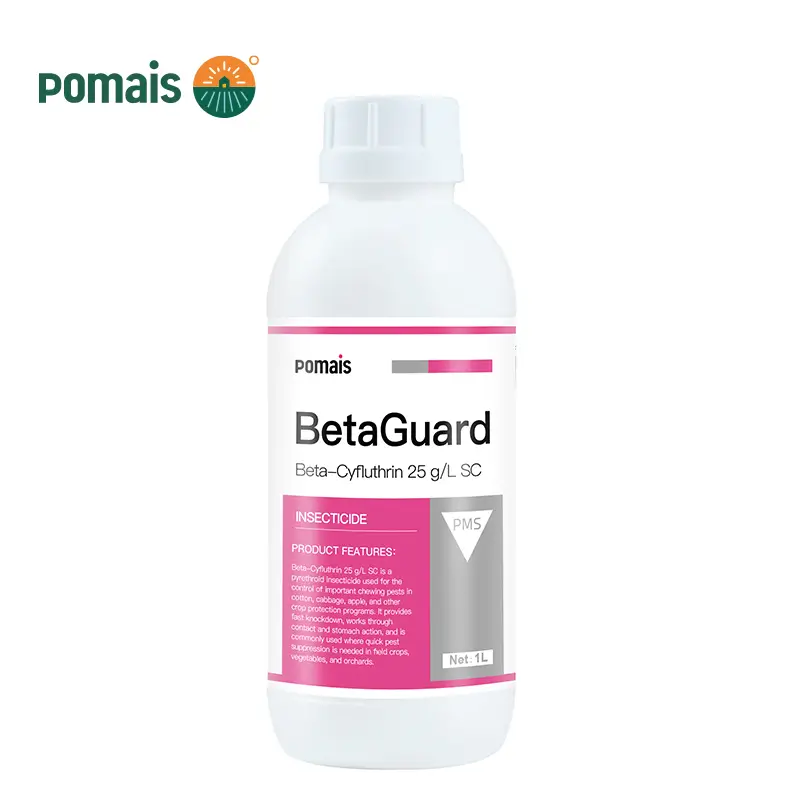
Beta-Cyfluthrin 25 g/L SC
Beta-Cyfluthrin 25 g/L SC is a pyrethroid insecticide used for the control of important chewing pests in cotton, cabbage, apple, and other registered crops. Beta-cyfluthrin is classified in IRAC Group 3A, and FAO describes it as a contact and stomach poison with rapid knockdown, long-lasting efficacy, and non-systemic behavior in plants.
This formulation is used where crops need quick pest suppression, foliar spray application, and a practical liquid insecticide format. The current product information places it in field crops, vegetables, and orchards, with crop directions including cotton, cabbage, and apple.
Stable Formulation Supply
Flexible Pack Sizes
Custom Label Support
Export Service Assistance
Beta-Cyfluthrin 25 g/L SC Description
Beta-Cyfluthrin 25 g/L SC Description
| Item | Details |
|---|---|
| Product Name | Beta-Cyfluthrin 25 g/L SC |
| Active Ingredient | Beta-Cyfluthrin |
| Content | 25 g/L |
| Formulation | SC |
| Product Type | Insecticide |
| Chemical Group | Pyrethroid |
| IRAC Group | 3A |
| Mode of Action | Contact action and stomach action |
| Plant Behavior | Non-systemic |
| Application Method | Foliar spray |
These technical identifiers match the current product information, while SC is the standard formulation code for suspension concentrate under the CIPAC formulation code system.
Main Functions
Beta-Cyfluthrin 25 g/L SC is mainly used to:
- Control chewing pests
- Deliver fast knockdown
- Reduce feeding damage on leaves, bolls, and fruit
- Support foliar insect control in registered crops
- Provide a Group 3A option in insecticide programs
Its main technical role is rapid contact-and-stomach insect control in crops where pest pressure can rise quickly.
Mode of Action
Beta-Cyfluthrin belongs to the pyrethroid group and acts on the insect nervous system. Pyrethroids are sodium channel modulators in the IRAC classification system, and FAO describes beta-cyfluthrin as a contact and stomach poison with rapid knockdown activity.
Because it is not systemic in plants, good spray coverage remains important for stable field performance. This makes Beta-Cyfluthrin 25 g/L SC suitable for programs where pests are active on plant surfaces and feeding sites.
Target Pests
Beta-Cyfluthrin 25 g/L SC is used for important crop pests such as:
- Cotton bollworm
- Pink bollworm
- Cabbage worm
- Peach fruit moth
- Leafminer-related pests in apple
These pest directions are listed in the current product information and fit the product’s role as a fast-acting pyrethroid insecticide for chewing-pest control.
Suitable Crops and Application Areas
Beta-Cyfluthrin 25 g/L SC is suitable for registered crop programs that include:
- Cotton
- Cabbage
- Apple
FAO also describes beta-cyfluthrin as being used in agriculture, horticulture, protected crops, and viticulture, which supports a broad crop-protection use direction depending on local registration scope.
Application Guidance
Beta-Cyfluthrin 25 g/L SC is generally used as a foliar spray. Uniform crop coverage is important, especially when target pests are active on leaves, fruit surfaces, or crop canopy areas.
In the current product information, application timing is described as follows:
- for cotton bollworm and pink bollworm, spray during the egg hatching peak or early larval stage
- for cabbage worm, spray during the young larval stage
- for apple pests, spray at the early pest occurrence period
Final dosage, interval, and crop-specific use directions should follow the approved local label in the destination market.
Formulation Features
SC means suspension concentrate. CIPAC defines SC as suspension concentrate (= flowable concentrate). This is a liquid formulation type designed for dilution with water before spraying.
The SC formulation gives Beta-Cyfluthrin 25 g/L SC a liquid format suitable for standard agricultural spray use. It is a practical formulation route for routine foliar application in field crops, vegetables, and orchards.
Product Advantages
Beta-Cyfluthrin 25 g/L SC stands out for these reasons:
- Fast knockdown performance
- Group 3A pyrethroid chemistry
- Contact and stomach action
- Non-systemic insect control
- SC liquid formulation
- Use in cotton, cabbage, apple, and other registered crops
Its main technical strength is the combination of rapid field response and a well-established pyrethroid mode of action.
Safety and Use Precautions
Beta-Cyfluthrin 25 g/L SC should be handled carefully during mixing, spraying, storage, and transport. The current product information states that it should not be mixed with alkaline materials and should be kept away from bees, silkworm areas, mulberry fields, fish ponds, and aquaculture zones. It also advises the use of protective clothing, gloves, and a mask during handling and recommends rotation with products of different modes of action.
As a pyrethroid insecticide, environmental care and label-based use remain important parts of responsible handling.
Storage and Transport
Store Beta-Cyfluthrin 25 g/L SC in the original sealed package in a cool, dry, and well-ventilated place. Keep it away from food, drink, feed, moisture, direct sunlight, heat, and fire sources.
During transport, packages should be protected from rain, pressure, inversion, and rough handling to maintain formulation stability and packaging safety.
FAQ
What kind of insecticide is Beta-Cyfluthrin 25 g/L SC?
Beta-Cyfluthrin 25 g/L SC is a pyrethroid insecticide in IRAC Group 3A.
How does Beta-Cyfluthrin 25 g/L SC work?
It works through contact action and stomach action and provides rapid knockdown against susceptible pests.
Is Beta-Cyfluthrin 25 g/L SC systemic?
No. Beta-cyfluthrin is described as non-systemic in plants.
Which pests can Beta-Cyfluthrin 25 g/L SC control?
It is used for pests such as cotton bollworm, pink bollworm, cabbage worm, peach fruit moth, and leafminer-related pests in apple.
What does SC mean in Beta-Cyfluthrin 25 g/L SC?
SC means suspension concentrate.