Trifloxystrobin 50% WDG
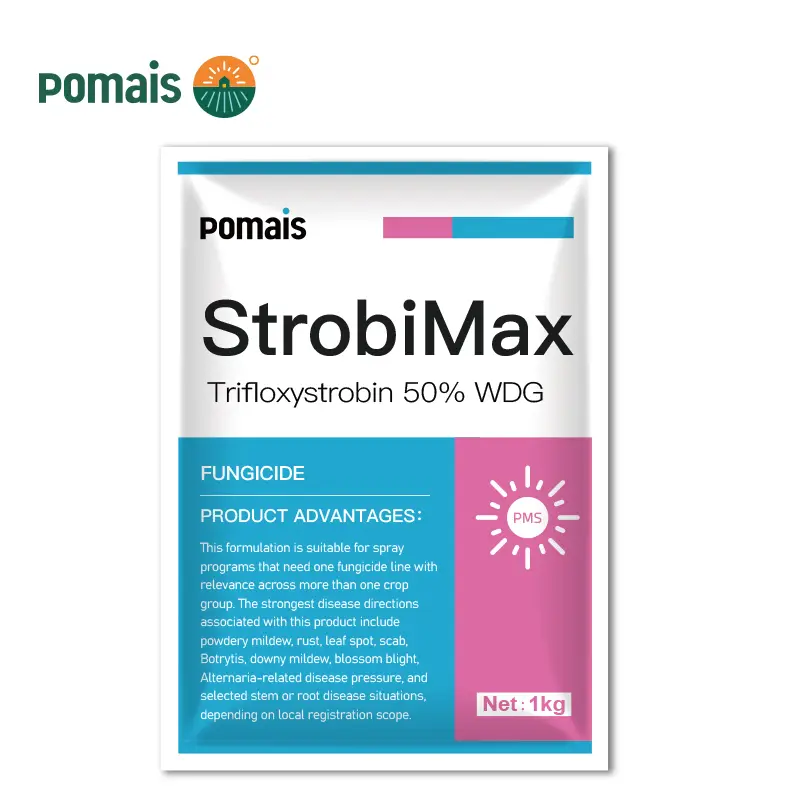
Trifloxystrobin 50% WDG is a strobilurin fungicide used for foliar disease management in registered crop programs. It belongs to FRAC Group 11 and works as a QoI fungicide, which means it acts as a respiration inhibitor in fungal pathogens. The listed crop direction includes fruit crops, vegetables, cereals, ornamentals, and tropical crops, with disease use patterns built around common foliar disease pressure across these crop systems.
This formulation is suitable for spray programs that need one fungicide line with relevance across more than one crop group. The strongest disease directions associated with this product include powdery mildew, rust, leaf spot, scab, Botrytis, downy mildew, blossom blight, Alternaria-related disease pressure, and selected stem or root disease situations, depending on local registration scope.
Stable Formulation Supply
Flexible Pack Sizes
Custom Label Support
Export Service Assistance
Trifloxystrobin 50% WDG Description
Trifloxystrobin 50% WDG Description
| Item | Details |
|---|---|
| Product Name | Trifloxystrobin 50% WDG |
| Active Ingredient | Trifloxystrobin |
| Formulation | 50% WDG |
| Product Type | Fungicide |
| Chemical Group | Strobilurin |
| FRAC Group | 11 |
| Mode of Action | Respiration inhibitor (QoI fungicide) |
| Main Product Character | Broad foliar disease control for professional spray programs |
| Typical Crop Direction | Fruit, vegetables, cereals, ornamentals, and tropical crops |
| Application Method | Spray application according to the approved local label |
Main Functions
Trifloxystrobin 50% WDG is mainly used to:
- Control foliar fungal diseases
- Reduce disease pressure across several crop lines
- Support preventive spray programs
- Support early disease intervention in registered crops
- Provide a FRAC 11 fungicide option in rotation programs
Its main role is broad foliar disease suppression in crop systems where leaf, stem, flower, and fruit infection can reduce yield, appearance, or market quality. QoI fungicides are especially effective when used early in disease development, and FRAC emphasizes their value in preventive treatment programs.
Mode of Action
Trifloxystrobin is a QoI fungicide that blocks fungal respiration. FRAC identifies QoI fungicides as Group 11 and notes that they are very effective at preventing spore germination, which is why they are best used at the early stages of disease development.
This mode of action gives Trifloxystrobin 50% WDG a clear technical role in programs that need a respiration-inhibiting fungicide with strong foliar-disease relevance. Because QoI fungicides share cross-resistance issues and are considered a high-resistance-risk group, rotation with fungicides from different modes of action remains important.
Target Diseases
Trifloxystrobin 50% WDG is mainly associated with the following disease directions:
- Powdery mildew
- Rust
- Leaf spot
- Scab
- Botrytis
- Downy mildew
- Blossom blight
- Alternaria-related foliar disease pressure
- Selected stem and root disease situations
These disease directions are the core disease-use lines listed for the formulation and match the broader foliar-disease spectrum commonly associated with QoI fungicides.
Suitable Crops and Application Areas
Trifloxystrobin 50% WDG is suitable for registered crop programs that include:
- Cereals
- Fruit crops
- Vegetables
- Ornamentals
- Tropical crops
It can also be used for apples, pears, grapes, strawberries, cucurbit crops, and fruiting vegetables. This gives the formulation a practical place in multi-crop fungicide programs where foliar disease pressure is a recurring issue. Final crop scope should follow the approved local label in the destination market.
Application Guidance
Trifloxystrobin 50% WDG should be used according to the approved local label. It is intended for spray programs where foliar disease pressure needs to be managed before it becomes severe. Because QoI fungicides are strongest as preventive treatments, early application timing remains important.
In general, this formulation is suitable when:
- the crop faces powdery mildew, rust, scab, or other foliar disease pressure
- the program needs a FRAC 11 fungicide
- the crop system includes fruit, vegetables, cereals, ornamentals, or tropical crops
- the disease program requires rotation-based management
Final dosage, interval, and crop-specific use directions should follow the local approved label.
Formulation Features
WDG means water-dispersible granule. This is a dry granule formulation that disperses in water before spray application. The product information positions 50% WDG as the formulation identity of this product, and this type of formulation is widely used in professional foliar spray programs.
The technical value of Trifloxystrobin 50% WDG lies in combining a concentrated dry granule format with a Group 11 QoI fungicide for multi-crop foliar disease management. This makes the product suitable for standard spray preparation in registered agricultural use.
Product Advantages
Trifloxystrobin 50% WDG stands out for these reasons:
- FRAC 11 QoI fungicide profile
- Respiration-inhibiting mode of action
- Strong fit for preventive spray programs
- Broad relevance across fruit, vegetables, cereals, ornamentals, and tropical crops
- Target disease range that includes mildew, rust, scab, Botrytis, and foliar leaf disease pressure
- Water-dispersible granule formulation
Its main technical strength is the combination of broad crop relevance and a well-defined QoI fungicide mode of action in a dry granule spray format.
Safety and Use Precautions
Trifloxystrobin 50% WDG should be handled carefully during mixing, spraying, storage, and transport. Because it is a FRAC Group 11 fungicide, it should be used in a rotation-based disease-management program rather than repeated as the only fungicide mode of action. FRAC notes that QoI fungicides carry a high resistance risk, and the current product information also places this formulation within stewardship-based program planning.
Important points include:
- follow the approved local label
- avoid repeated exclusive use without rotation
- wear proper protective clothing, gloves, and face protection
- apply under suitable foliar spray conditions
- avoid contamination of sensitive aquatic areas where local rules require it
Trifloxystrobin poses a high ecotoxicological risk to the aquatic environment; therefore, responsible handling remains crucial.
Storage and Transport
Store Trifloxystrobin 50% WDG in the original sealed package in a cool, dry, and well-ventilated place. Because this is a water-dispersible granule formulation, packaging should be protected from moisture, water exposure, bag damage, and rough handling so the granules remain stable before use. This storage logic is consistent with the dry granule nature of the formulation shown in the product information.
FAQ
What is Trifloxystrobin 50% WDG mainly used for?
It is mainly used for foliar disease management in registered crops, especially where powdery mildew, rust, leaf spot, scab, Botrytis, downy mildew, and blossom blight are important disease directions.
What fungicide group does Trifloxystrobin belong to?
Trifloxystrobin belongs to the QoI fungicides in FRAC Group 11.
Is Trifloxystrobin mainly preventive or curative?
The current product information presents it as having preventative and curative action, while FRAC emphasizes that QoI fungicides are especially effective when used preventively at the early stages of disease development.
What crops are most relevant to Trifloxystrobin 50% WDG?
The strongest crop directions include cereals, fruit crops, vegetables, ornamentals, and tropical crops, with examples such as apples, pears, grapes, strawberries, cucurbits, and fruiting vegetables, depending on local registration scope.
What does WDG mean in Trifloxystrobin 50% WDG?
WDG means water-dispersible granule, a dry formulation dispersed in water before spray application.