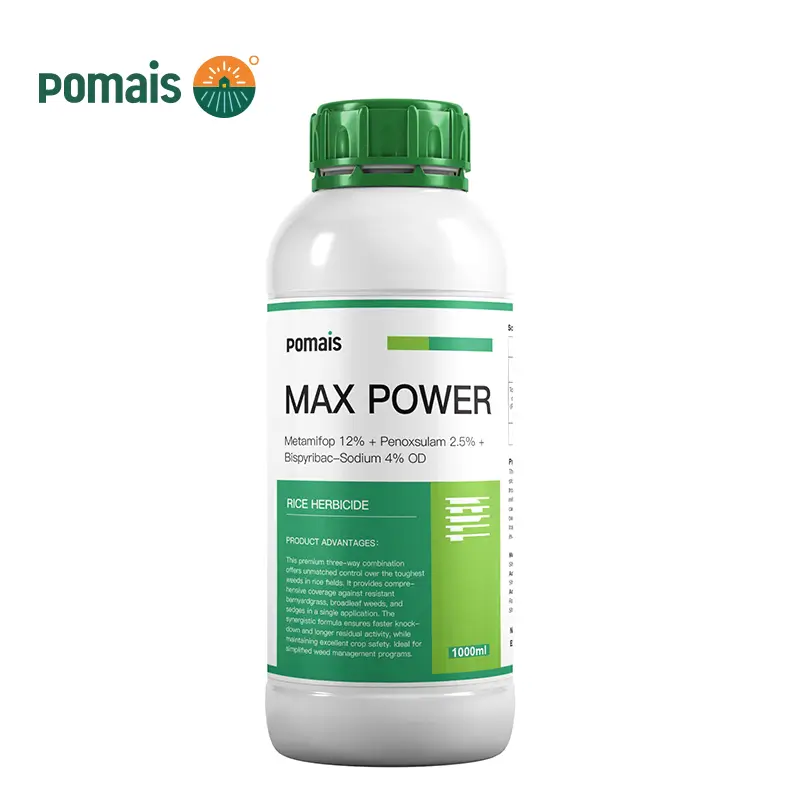
Metamifop 12% + Penoxsulam 2.5% + Bispyribac-Sodium 4% OD
Metamifop 12% + Penoxsulam 2.5% + Bispyribac-Sodium 4% OD is a selective post-emergence herbicide for rice. It is designed for rice weed control where grass pressure is the main problem, with additional relevance for sedges and selected broadleaf weeds according to the approved local label. The current product information positions it clearly as a rice herbicide combination rather than a general multi-crop herbicide.
This formulation combines one ACCase-inhibiting grass herbicide with two ALS-inhibiting rice herbicides. That gives the product a clear technical role in rice programs that need broader post-emergence weed control than a single grass herbicide alone.
Stable Formulation Supply
Flexible Pack Sizes
Custom Label Support
Export Service Assistance
Metamifop 12% + Penoxsulam 2.5% + Bispyribac-Sodium 4% OD Description
Metamifop 12% + Penoxsulam 2.5% + Bispyribac-Sodium 4% OD Description
| Item | Details |
|---|---|
| Product Name | Metamifop 12% + Penoxsulam 2.5% + Bispyribac-Sodium 4% OD |
| Product Type | Herbicide |
| Formulation | OD (Oil Dispersion) |
| Total Active Ingredients | 18.5% |
| Active Ingredients | Metamifop 12% + Penoxsulam 2.5% + Bispyribac-Sodium 4% |
| Technical Positioning | Group 1 + Group 2 rice herbicide combination |
| Crop Positioning | Rice programs |
| Weed Positioning | Post-emergence rice weed control; final spectrum follows local label |
| Application Direction | Use according to the approved local label |
Main Functions
Metamifop 12% + Penoxsulam 2.5% + Bispyribac-Sodium 4% OD is mainly used to:
- Control grass weeds in rice
- Support post-emergence control of sedges
- Support post-emergence control of selected broadleaf weeds
- Fit direct-seeded and other registered rice systems
- Provide a rice-focused herbicide option with more than one mode of action
Its main technical role is rice weed control after crop emergence, with the strongest fit in programs where grass weeds are central and mixed infestations are also part of the field picture. The current product page states exactly that weed structure.
Mode of Action
Metamifop is an ACCase-inhibiting herbicide used in paddy fields to control susceptible grass weeds. Scientific studies describe metamifop as a herbicide that inhibits acetyl-CoA carboxylase and is applied in rice fields for grass-weed control.
Penoxsulam is a Group 2 ALS inhibitor. Official label materials describe penoxsulam herbicides as selective post-emergence weed control products in rice, and EPA label language explicitly identifies penoxsulam as Group 2.
Bispyribac-sodium is also a Group 2 ALS inhibitor. Label and technical materials describe bispyribac-sodium as a post-emergence systemic herbicide that works by inhibiting the ALS enzyme.
Together, this formulation is best described as one Group 1 herbicide plus two Group 2 herbicides in one rice OD formulation. That description is consistent with the current product page and with the known modes of action of the three active ingredients.
Target Weeds
This herbicide as a post-emergence rice weed-control tool for situations where grass pressure is important, with added relevance for sedges and broadleaf weeds where the local label allows those claims.
In technical terms, the weed logic of this formulation is:
- Metamifop provides the strongest grass-control anchor
- Penoxsulam broadens the profile toward grass, sedge, and broadleaf relevance in rice
- Bispyribac-sodium adds further post-emergence support for mixed weed pressure in rice systems
Final weed claims should follow the approved local label in the destination market.
Suitable Crops and Application Areas
The clearest crop fit for Metamifop 12% + Penoxsulam 2.5% + Bispyribac-Sodium 4% OD is rice. The current product page does not position it as a general herbicide for broad field-crop use outside rice.
The herbicide also highlights direct-seeded rice as an important reference point, especially because metamifop is strongly associated with post-emergence grass control in direct-seeded rice systems. Final crop scope should always follow the approved local label in the destination market.
Application Guidance
This herbicide should be used according to the approved local label. Its strongest fit is post-emergence application in rice when target weeds are young and actively growing. Official label guidance for penoxsulam products states that best weed control is obtained when applied to small, actively growing weeds, and that same agronomic logic applies well to this type of rice mixture.
In general, this formulation is suitable when:
- the crop is rice
- the main pressure comes from grass weeds
- sedges or selected broadleaf weeds are also present
- the program needs a Group 1 + Group 2 rice herbicide structure
- the field includes direct-seeded rice or other registered rice systems
Final timing, dose, spray volume, and interval should follow the approved local label.
Formulation Features
OD means oil dispersion. The current product page identifies the formulation directly as OD (Oil Dispersion).
That means Metamifop 12% + Penoxsulam 2.5% + Bispyribac-Sodium 4% OD is supplied as a liquid oil-dispersion herbicide for dilution before field spraying. The defining formulation point is the OD liquid route, not a dry granule or wettable powder route.
Product Advantages
Metamifop 12% + Penoxsulam 2.5% + Bispyribac-Sodium 4% OD stands out for these reasons:
- Rice-specific post-emergence use direction
- Strong grass-weed control anchor from metamifop
- Two ALS-inhibiting herbicides for broader rice weed relevance
- Support for mixed infestations involving grasses, sedges, and selected broadleaf weeds
- OD liquid formulation
- Direct-seeded rice relevance
Its main technical strength is the combination of one ACCase herbicide plus two ALS herbicides in one post-emergence rice OD formulation.
Safety and Use Precautions
This herbicide should be handled carefully during mixing, spraying, storage, and transport. Because the formulation combines Group 1 and Group 2 herbicides, resistance management is important. Resistance in rice-field weeds to ALS inhibitors such as penoxsulam and bispyribac-sodium is well documented, and repeated exclusive reliance on the same chemistry should be avoided.
Important points include:
- follow the approved local label
- apply to small, actively growing weeds
- avoid repeated exclusive reliance on the same herbicide program
- wear proper protective clothing, gloves, and face protection
- avoid contamination of water bodies and non-target areas
These precautions are especially important in rice systems where repeated post-emergence herbicide use can increase resistance pressure.
Storage and Transport
Store Metamifop 12% + Penoxsulam 2.5% + Bispyribac-Sodium 4% OD in the original sealed package in a cool, dry, and ventilated place. The current product page also states that it should be protected from rain, heat, sun exposure, and package damage, and stored away from food, beverages, feed, and seed.
As an OD liquid formulation, containers should also be protected from leakage, rough handling, and prolonged poor storage conditions before use.
FAQ
What kind of herbicide is this product?
It is a selective post-emergence rice herbicide in OD formulation, built around metamifop, penoxsulam, and bispyribac-sodium for rice weed control.
What is the correct mode-of-action description?
The most accurate technical description is one Group 1 herbicide plus two Group 2 herbicides. Metamifop is the ACCase inhibitor, while penoxsulam and bispyribac-sodium are ALS inhibitors.
What weed groups is this herbicide mainly used for?
It is mainly used for rice weed control where grass pressure is important, with added relevance for sedges and selected broadleaf weeds according to the approved local label.
Is this mainly a direct-seeded rice herbicide?
Direct-seeded rice is an important reference point, especially for the metamifop part of the formulation, but final system fit should follow the destination-country label and registered use pattern.
What does OD mean in the product name?
OD means oil dispersion.