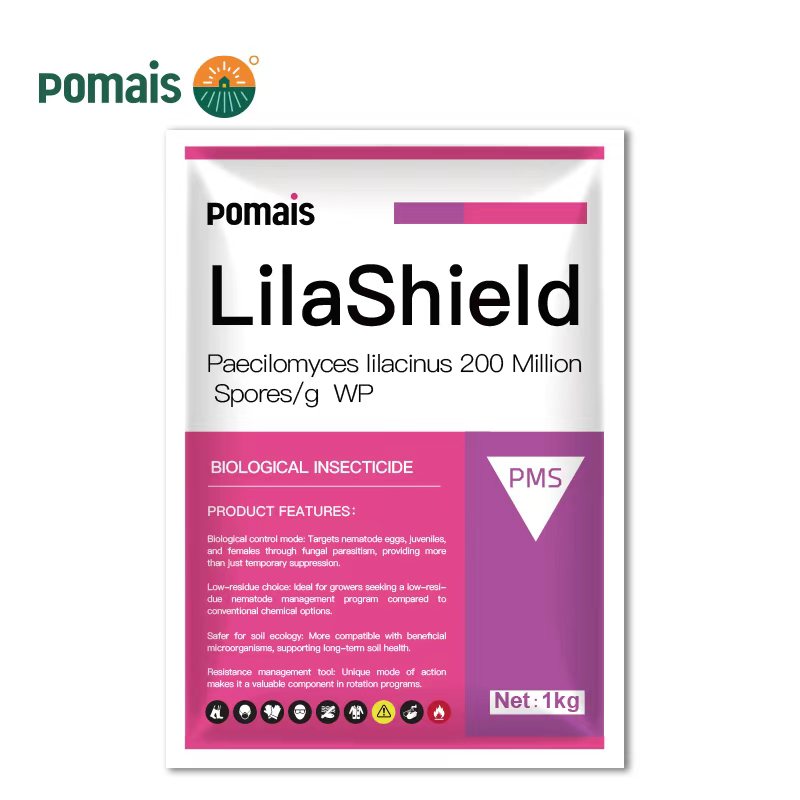
Paecilomyces lilacinus 200 Million Spores/g
Paecilomyces lilacinus 200 million spores/g is a fungal biological nematicide used for the management of plant-parasitic nematodes in the root zone. In current technical classification, Paecilomyces lilacinus is also recognized as Purpureocillium lilacinum, and IRAC places it in the nematicide category for fungal agents of unknown or uncertain mode of action (N-UNF).
This microorganism is used where crop protection depends on reducing nematode pressure around roots, lowering gall formation, and improving root health and crop establishment. It is especially relevant in programs aimed at root-knot nematodes and other important soil nematodes that weaken plant growth and reduce yield potential.
Stable Formulation Supply
Flexible Pack Sizes
Custom Label Support
Export Service Assistance
Paecilomyces lilacinus 200 Million Spores/g Description
Paecilomyces lilacinus 200 Million Spores/g Description
| Item | Details |
|---|---|
| Product Name | Paecilomyces lilacinus 200 million spores/g |
| Active Microorganism | Paecilomyces lilacinus |
| Scientific Synonym | Purpureocillium lilacinum |
| Microbial Concentration | 200 million spores/g |
| Product Type | Biological nematicide |
| IRAC Category | N-UNF Fungal agents of unknown or uncertain mode of action |
| Main Use Direction | Root-zone management of plant-parasitic nematodes |
| Application Direction | Use according to the approved local label |
Main Functions
Paecilomyces lilacinus 200 million spores/g is mainly used to:
- Suppress plant-parasitic nematodes in the root zone
- Reduce nematode egg hatch and juvenile survival
- Lower gall formation and root damage
- Support healthier root development
- Improve crop establishment under nematode pressure
This biological product is designed for soil and root-zone pest management, not for broad foliar insect control. Its technical role is strongest where nematode pressure builds in the root system and affects plant vigor from the early growth stage.
Mode of Action
Paecilomyces lilacinus acts as a nematophagous fungus. It colonizes the root-zone environment and attacks nematode eggs and other susceptible life stages. Microscopic studies show that the fungus can penetrate eggs directly, contact juveniles, and reduce both egg hatching and juvenile survival.
This is why Paecilomyces lilacinus 200 million spores/g is better understood as a biological root-zone control tool. Its strength is not instant knockdown. Its strength is gradual nematode suppression through biological activity around the root system and the nematode life cycle.
Target Pests
Paecilomyces lilacinus 200 million spores/g is mainly suited to plant-parasitic nematodes. The most important target group is root-knot nematodes, especially where gall formation and root injury reduce plant performance. Studies also describe activity and commercial relevance against other nematode groups such as cyst nematodes, burrowing nematodes, reniform nematodes, root lesion nematodes, and false root nematodes.
This gives the product a clear role in crop systems where soil nematodes are a recurring production problem and where root-zone management is more important than foliar pest control.
Suitable Crops and Application Areas
Paecilomyces lilacinus 200 million spores/g is suitable for crop programs where nematode pressure around the root zone affects plant establishment, root growth, nutrient uptake, and final yield. It is especially relevant in crops that are sensitive to root-knot nematode injury and other soil nematode problems. Research has shown useful performance in systems such as eggplant, and commercial use directions described in the literature extend to a broad range of crop situations where nematodes are an economic problem.
The final crop scope, target nematodes, and application pattern should follow the approved local label in the destination market. Different markets may have different registrations and different crop-use directions.
Application Guidance
Paecilomyces lilacinus 200 million spores/g should be used according to the approved local label. Because it is a biological nematicide, it fits best in programs that focus on root-zone application, early intervention, and nematode prevention or suppression before severe root damage develops.
In general, this product is suitable when:
- the field has a history of root-knot nematode or other soil nematode problems
- the crop is sensitive to root damage
- the main management target is the root zone
- the program needs a biological nematicide rather than a conventional chemical route
The exact application method, timing, and dosage should follow the local approved label.
Formulation Features
The 200 million spores/g specification defines the microbial concentration of the product. It indicates that this is a high-spore biological formulation designed for use as a root-zone nematode management product.
The technical value of this type of product comes from the living fungal agent itself. Paecilomyces lilacinus is intended to act in the soil-root environment, where nematode eggs, juveniles, and root infection pressure are concentrated.
Product Advantages
Paecilomyces lilacinus 200 million spores/g stands out for these reasons:
- Biological nematicide function
- Root-zone pest management focus
- Direct activity against nematode eggs and juveniles
- Useful fit for root-knot nematode programs
- Supports healthier roots and crop establishment
- Suitable for integrated nematode management
Its main technical advantage is the combination of nematode suppression and root-zone biological activity. In controlled and greenhouse studies, P. lilacinum reduced gall numbers, reduced nematode populations, and improved plant growth indicators under nematode pressure.
Safety and Use Precautions
Paecilomyces lilacinus 200 million spores/g should be handled carefully during mixing, application, storage, and transport. It should be used according to the approved local label and standard agricultural safety practice.
Important points include:
- keep away from food, feed, and drinking water
- avoid contamination of non-target areas
- wear proper protective clothing, gloves, and face protection
- use the product under suitable field conditions for biological activity
- follow the approved local label for safe handling and use
Storage and Transport
Store Paecilomyces lilacinus 200 million spores/g in the original sealed package in a cool, dry, and well-ventilated place. Keep it away from direct sunlight, excessive heat, moisture, and contamination.
During transport, packaging should be protected from:
- water exposure
- high temperature
- bag damage
- rough handling
Good storage helps maintain stable product quality before use.
FAQ
What kind of product is Paecilomyces lilacinus 200 million spores/g?
It is a fungal biological nematicide used for root-zone management of plant-parasitic nematodes.
What does Paecilomyces lilacinus mainly control?
It is mainly used against root-knot nematodes and other important soil nematodes that damage plant roots.
How does Paecilomyces lilacinus work?
It acts as a nematophagous fungus that attacks nematode eggs and other susceptible life stages, reducing egg hatch, juvenile survival, and root infection pressure.
What does 200 million spores/g mean?
It refers to the microbial concentration of the product and shows that the formulation is supplied as a high-spore biological preparation.
How should Paecilomyces lilacinus 200 million spores/g be used?
It should be used according to the approved local label, with attention to root-zone timing, crop registration, and local field conditions.